


The treatment with demethylating agents represents an innovative and targeted therapeutic approach against HPV-induced tumors.1
Such an approach is particularly promising for pre-cancerous diseases in the anogenital area. In Europe alone, 540,000 new cases of pre-cancerous lesions in the internal and external genital area as well as in the anal canal arise every year.2 Currently, surgical removal (excision) and/or ablation (destruction) of the affected tissue, for example using a laser, represents the treatment standard for HPV-induced pre-cancerous conditions. These procedures also remove healthy tissue surrounding the lesions to various degrees, and some patients may experience consequences, such as bleeding, infections, or an increased risk of premature births (in cases of cervical lesions). Depending on the anatomical localization of the pre-cancerous conditions, up to a third of the affected patients will experience a relapse after treatment. This situation emphasizes the high need for effective, yet gentle, local therapies against HPV-induced pre-cancerous lesions.3
To make our therapeutic approach a practical application, we have conducted extensive development work to produce, for the first time, a locally effective (topical) dosage form of a demethylating agent.
Through this, it is possible to apply the active ingredient directly onto the diseased areas in the skin and mucous membranes. Thereby, the demethylating agent shall be taken up into the tumor cells while the surrounding normal tissue is largely spared. A topical dosage form further allows the affected patients to self-administer the treatment, thus integrating it easily into their everyday lives.
We have successfully determined early data on the safety and tolerability, as well as preliminary efficacy of the developed investigational medicinal product in a first clinical trial (DelVIN study) in patients with HPV-induced pre-cancerous conditions at the vulva. These lesions are referred to as vulvar intraepithelial neoplasia (VIN) grade 2/3.
Furthermore, by developing further dosage forms we aim to make our new therapeutic approach usable for other HPV-induced pre-cancerous conditions in the anogenital area as well as for other tumors responsive to demethylating treatment. The following figure shows the current status of our development:
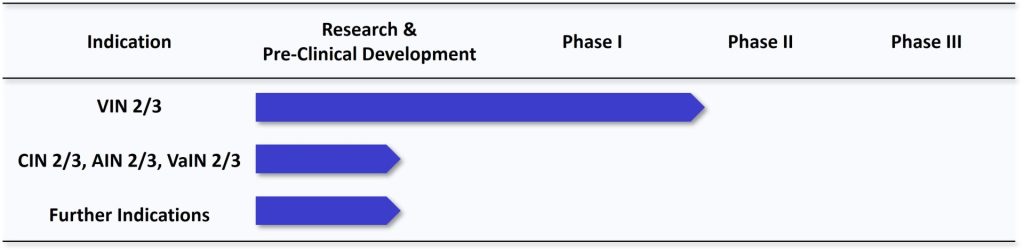
VIN, CIN, AIN, VaIN 2/3: Vulvar, Cervical, Anal, Vaginal Intraepithelial Neoplasia Grade 2/3

Address
ViMREX GmbH
Im Neuenheimer Feld 224
69120 Heidelberg, Germany
Contact
E-Mail: vimrex@vimrex.com
Further Information
© 2026 ViMREX GmbH